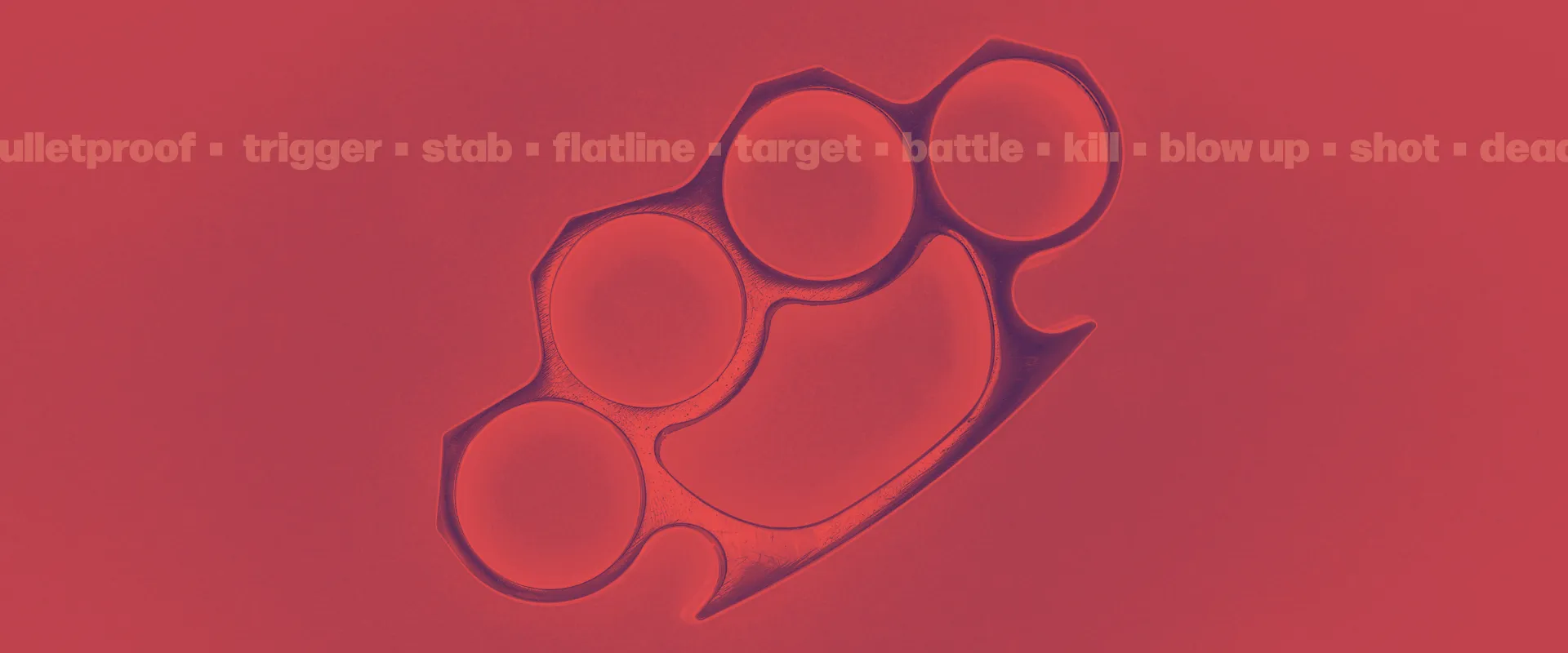
Hot Take: Violent Language Has No Place in Marketing
 I’m no historian, but it seems that the world has always been a violent place. (I’m looking at you, Attila the Hun.) While I can’t do anything about war or politics, as the Creative Director at a marketing agency, there is one tiny way I can make life a little less hostile: cutting cruel language out of our marketing content.
The Case for Softer Marketing Language
With mental health issues on the rise, particularly among the youngest generations, it’s important, to say the very least, to increase access to wellness resources and make the world a little kinder wherever we can.
One of my favorite Communications theories—nerd alert!—is the (controversial) Sapir-Whorf hypothesis, also known as linguistic relativity, which posits that a person’s language shapes their perception of reality—and vice versa. Consider the fact that Indigenous North American nations had the word “Two Spirit” to describe a third gender. In contemporary English-speaking society, we don’t have an equivalent. And, as the Whorf hypothesis and I would argue, that lack has had devastating impacts on gender expansive folks. When you don’t even have a word to describe someone’s existence, how can you really respect it?
The opposite can be true, too. After centuries of imperialism and linguistic assimilation, Americans have accumulated a shit-ton of words for bloodshed and brutality. In Nonviolent Communication: A Language of Life, Marshall Rosenberg, PhD, argues that the existence of so much violent vernacular creates a culture of violent thoughts and behaviors. Which brings me back to my original point: as people who touch many people with content, marketers have a responsibility to use more compassionate words.

The Language to Remove in Your Marketing
Marketers reach thousands to millions of consumers daily. That’s a lot of power, and as Spider-Man’s Uncle Ben said, that comes with a lot of responsibility. I understand why we do it; aggressive language tends to get more aggressive results. But aggressive doesn’t have to mean violent. We have to believe that we can do better, both as humans and as content creators.
Below is a not-at-all-comprehensive list of common words that appear in marketing content but, in a kinder world, really shouldn’t be there.
Bulletproof / bite the bullet
No one needs to be reminded of weaponry when they’re being sold a blender. (Sorry, NutriBullet.) Many people are surprised, once they start to take inventory of it, how often the word “bullet” shows up in content. Bite the bullet? Magic bullet? Bullet point? “Bullets” are constantly flying around in conversation. While your marketing argument may be bulletproof, there are other ways you communicate that message.

What to say instead:
- Bulletproof → invulnerable, ironclad, impervious
- Bite the bullet → stop avoiding it
- Magic bullet → problem solver, miracle
- Bullet point → list item, icon
Pull the trigger / trigger happy
Honestly, we are guilty of this one at Elevate My Brand. We used to tell clients all the time that we needed to “pull the trigger” on a project to get started ASAP. One could say we were even “trigger happy” with the phrase. But there’s no reason to use such a “triggering” (there it is again) word or phrase when there are equally effective options.
What to say instead:
- Pull the trigger → launch, get started, catapult
- Trigger happy → eager, antagonistic
Take a stab at it
If you use this phrase, this may feel like a “stab in the back,” but you don’t need to bring a knife to a content fight. There are more peaceful ways to make your point without conjuring up the image of someone taking violent swings with a sharp blade.
What to say instead:
- Take a stab at it → guess, try, make a go of it, take a first pass
- Stab in the back → betray, abandon, double-cross
Flatline
You may not have expected to see this word in this list, but I’ve seen it quite a lot in online content. A reference to the continuous solid line on a heart rate monitor, indicating that a patient has no heartbeat, “flatline” has no other meaning than dead, or at least almost dead. If you’re simply talking about a line that’s flat, then that’s another story, but if you mean “flatline,” kindly choose an alternative.
What to say instead:
- Flatline → go stale, near the end, lose its luster
Target audience / on target
Among marketers, this is probably the most controversial phrase on the list, but I’d argue that the era of “target audiences” is over. Target originally meant a “small shield” in 1400s Middle English, but today it pretty unambiguously means something to be pursued, aimed at or fired at. When you pair it with “audience,” it becomes obvious why this phrase may feel violent. And even when the word “target” appears on its own, there’s usually a less violent alternative.
What to say instead:
- Target audience → buyer personas, audience archetypes, ideal customers, market segment
- On target → accurate, relevant, on the same page, on the nose
- Target date → scheduled date, intended date,
- Off target → inaccurate, stray, askew, off course
- Sitting target → vulnerability, easiest option, unprotected
- Sales target → sales goal, sales objective
Battle plan / battleground
Brands that appeal to men are particularly prone to using violent language like “battle.” I’ve never been in the armed forces, but I imagine saying “battling with baldness” is borderline insulting to someone who’s been on a real-life battlefield. Thankfully, this is one of the easiest phrases to replace in your marketing content.
What to say instead:
- Battle plan → action plan, proposal, outline, course of action, game plan
- Battle cry → tagline, slogan, watchword, rallying cry
- Battleground → territory, market, field
- Battle it out → compete, contest, vie, settle, sort it out
Killed it / overkill
I won’t lie; it feels wonderful when a colleague says you “killed it” on that project at work. But a rose by any other name would still smell as sweet, right? You can get the praise you deserve without using language that evokes the imagery of murder. There are actually a lot of phrases with the word “kill” that suggest violence to animals, which caused PETA to share a list of animal-friendly idioms back in 2018. Most of them are silly, but that only makes them more memorable.
What to say instead:
- Killed it → aced it, triumphed, did it
- Overkill → excessive, too much, feeding a fed horse
- Killing time → wasting time, pussyfooting around
- Killjoy → party pooper, complainer, cynic, drag
- Go for the kill → take action, be decisive, seal the deal, secure the win
- Dressed to kill → dressed to impress, styled to the gods, dolled up
- Buzzkill → prude, bore, pain in the neck, flat tire, wet blanket
Blow up / blown away
Your viral new product may be gaining popularity really quickly, but it doesn’t have to be “blowing up” on TikTok. The phrase “blow up” makes me think of a ticking time bomb or a giant mushroom cloud on the horizon. In a world where war feels like an inescapable daily reality, I’d rather not have that image come to mind completely unnecessarily.
What to say instead:
- Blow up → inflate, become popular, overstate, exaggerate, make available, spread
- Blown away → impressed, wowed, floored, slack-jawed
- Full-blown → completely, totally,
- Final blow → defeat, finisher, closure
- Blow off → ghost, avoid, forget, abandon
- Soften the blow → lessen the impact, make it easier, be tactful
Give it a shot / shoot for
Even I, a bleeding heart marketing expert, have been known to “take a shot in the dark” or request a colleague “shoot me an email.” All I’m really saying in those instances, respectively, is that I’m making an attempt or asking someone to send an email, which are much friendlier ways to say the same thing. So, why not opt for an alternative instead?
What to say instead:
- Give it a shot → attempt, do one’s best, give it all one’s got, strive, pursue, give it a whirl
- Shoot for → aim at, try, do one’s best
- Straight shooter → direct, no bullshit, honest, forthcoming
- Shoot down → deny, criticize, disparage, deflate, let down easily, humble
- Shoot the shit → chitchat, kiki, converse, schmooze, yap
Dead / deadline
Remember the PETA idioms I mentioned earlier? One of the most popular ones is “feed a fed horse,” an alternative to “beat a dead horse.” As ridiculous as the phrase may sound, I started using this at work and with friends, and now everyone I know uses it—some to use less violent language, and some because it’s more fun. Since I’m an aspiring death doula, I don’t think death has to be a sad or sore topic, but I do think it’s pertinent to avoid mentioning it in most spaces unless you have to, including your marketing content.
What to say instead:
- Dead → defunct, expired, powerless, checked out, numb, nonfunctional
- Deadline → time limit, goal, zero hour, time frame, cutoff date
- Dead end → impasse, obstacle, roadblock, leading nowhere
- Dead ringer → carbon copy, doppelganger, replica, lookalike, spitting image
- Dead set → determined, adamant, solid, relentless, strict, strait-laced
- Deadpan → blank, pokerfaced, serious, dry
The Nice Content Partner You’ve Always Needed
It’s easier said than done to take violent language out of your marketing, and it is basically impossible to replace each of these phrases all at once. Give yourself some grace in the process. Plus, the Quantum Zeno Effect, which most people know as the “watched pot never boils” phenomenon—I did warn you that I was a nerd—means it can be hard to see something when you’re looking at it. What you need is an accountability partner with an outside perspective to help you do it.
At Elevate My Brand, positivity is a core part of who we are as an agency. Partner with us to create compassionate content that converts, and, in the process, make the world a little better!
Cody H. Owens,
Content Director
Was this hot take not hot enough for you? Well, there's more where that came from, so click below to read our other posts in this super-spicy blog series.






_920x690.webp)