Is Your Marketing Agency Cheating You With AI?
When large language models (LLMs) like ChatGPT first burst onto the scene, many people called it an “equalizer.” The idea was that, with AI, anyone could create great graphics and smart marketing strategies. (Not necessarily true, but it’s what people said, okay?) But now that 88% of businesses worldwide use AI, it’s not a differentiator anymore.
What sets you apart isn’t if you use AI, but how you use AI.
And that couldn’t be truer in marketing. Unless it explicitly states otherwise, your marketing agency is probably using AI. It’s truly a godsend in terms of scaling content creation, streamlining operations, measuring data, etc.
Godsend or not, this shift has one detrimental effect on brands: you now have one more element to consider when choosing an outsourced marketing partner:
How does my marketing agency ethically and effectively use AI?
The ways agencies cheat you with AI
For the purposes of this blog post, let’s go ahead and assume that your agency is already limiting its use of AI to reduce its impact on the planet and marginalized communities. If you’re not confident that it is, that’s a problem. As an agency that works with ethical, diversity-driven businesses, we believe it’s critically important for brands and their vendor partners to be aligned in values.
Here’s some bad news, though: even marketers who use AI “responsibly” can still be cheating you.
Agencies need to be transparent not only about how often they use AI but also when and where. Why? Because you don’t want to pay for content that you could’ve made yourself with ChatGPT. At that point, you haven’t hired experts; you’ve hired warm bodies to type your needs into a computer. We think that’s unethical, too.
The importance of human-in-the-loop
Enter the concept “human in the loop.” Sometimes shortened to HITL, it’s a method of managing AI that ensures human oversight at every stage of development and implementation. In marketing, applying HITL principles means making sure real people manage the process, devise the prompts, review the output, etc.
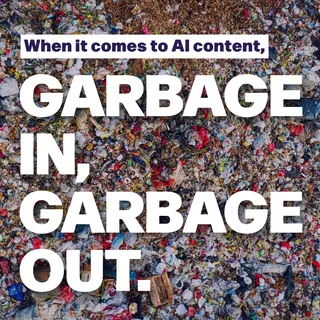
You want to make sure you’re paying experts with real-world experience in human connection. At the end of the day, marketing is about leveraging psychology to guide consumer behavior. LLMs require real human insight to be useful. We always say, “Garbage in, garbage out.”
Protect your brand’s investment in your marketing agency by ensuring the experts you hired are actually using their expertise. You can ask:
- Which AI platforms do you use?
- What prompts do you use for our brand?
- How do you minimize errors and AI hallucinations?
- How do you incorporate human expertise?
The best AI detection tools
The best way to ensure your marketing agency is not only using AI output but elevating it is to have a conversation. However, if it comes to it, you may want to use detection tools to make that determination on your own.
There are numerous tools online to detect AI’s presence in content, but before you use them, you need to understand one critical caveat: there’s no such thing as 100% accuracy in AI detection. After all, AI detection tools are, themselves, AI. Take what they say with a grain of salt.
Plus, the use of AI isn’t necessarily a bad thing! We use it to create content at scale at EMB when it makes sense for our client. It’s possible that your agency could have written such detailed prompts that the output requires zero revisions. In that case, an AI detector saying your copy is 100% AI is perfectly fine.
If you’re concerned that your marketing partner’s work is (a) made with AI and yet (b) still not moving the needle, then you can use tools to see for yourself.
1. For copy: GPTZero
This resource promises up to 99% accuracy. With high-quality technology and the support of nearly 400,000 educators, GPTZero can estimate when content was generated by ChatGPT or Google Gemini.
2. For visuals: Winston
Trusted by over 10 million users, Winston claims to detect deepfake images made with Google Nano Banana, Midjourney, ChatGPT, Stable Diffusion, Meta AI and others. It has a convenient 14-day free trial, too.
3. For voice: AI Voice Detector
AI voices are notoriously hard to detect, but AI Voice Detector is about as good as it gets. While some AI voice tools can only detect voices made with their own software, this resource promises to detect output from all major AI models.
4. For video: your own eyes
While AI video still has a long way to go, it’s getting harder and harder to tell the difference. You wouldn’t know that by searching for an “AI video detector,” though, because lots of them exist. The truth is that no software is as good as your own two eyes—yet. The Global Investigative Journalist Network (GIJN) compiled a list of seven ways to tell if a video is AI, and it’s our go-to resource.
The marketing agency you can trust
Creating content with AI is easy. Creating really good content with AI is hard. Concluding whether or not content was made with AI can feel impossible. You deserve a marketing agency that you can trust to use AI ethically and effectively.
Don’t let your agency cheat you. Ask the team to clearly communicate their philosophy and process, and to be transparent about which deliverables were made with AI—and to what extent.
Ready to talk about responsible AI-driven content creation?
Cody H. Owens,
Content Director
We have lots to say about AI and automation. Check out these other related blog posts from our team: