
The Key Differences Between Short-Tail and Long-Tail Keywords

Short-tail keywords? Medium-tail keywords?? Long-tail keywords??? What’s next—extra-long-tail keywords?
If you’re not a search engine optimization (SEO) expert like we are, then all of this “tail” talk may be confusing at best. But we promise that having a basic understanding of your brand’s keywords will ensure your content supports your business goals, even if you’re not the person creating any of the content—because keywords are everywhere.
So, exactly what is a keyword?
The term “keyword” didn’t start with marketers. In fact, it pre-dates the Internet by about 200 years. From its inception, it’s always meant “an important word that provides context.” In modern marketing, a keyword (sometimes called a “focus keyword”) is a word or phrase that provides context to search engines to help users find the best answer to their query.
Think about them like signage on stores in the mall. You enter the doors to find something specific, and then you walk around looking at storefronts and brand names for clues about where to find the item you need. Once you decide on a store, you enter and head straight to the department sign related to the item, like Women’s Clothes, Home Goods or Electronics. You may even use even longer, more specific keywords to find what you want within that department (e.g., Petite Women’s Clothes, Mid-Century Modern Decor or Cell Phones & Accessories).
You probably don’t even recognize you’re using “keywords” to get to the items you need, but that’s exactly what’s going on. And much like stores use signage, online brands use keywords to get you to the right store (website), department (site section) and aisle (landing page).
What’s the difference between short-tail and long-tail keywords?
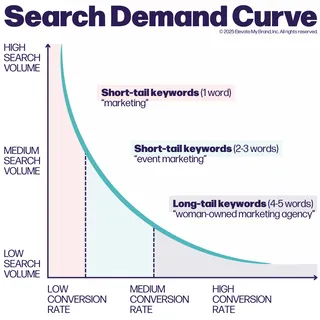
Short-tail keywords, which are sometimes called “head terms,” are typically only one word but can be two words or a very short phrase, as long as that phrase is still generic. Think “shoes,” “snacks,” or “legal advice.” These keywords live at the “head” of the Search Demand Curve: high monthly search volume, high search competition and broad search intent.
In contrast, long-tail keywords are more descriptive phrases—often three or more words—such as “running shoes for women with flat feet,” “organic snacks for toddlers” or “startup tech lawyer in Los Angeles.” These keywords fall on the “long tail” of the Search Demand Curve, where individual search volume is lower, but search intent is more specific and conversion potential is stronger.
It might sound like long-tail keywords are just better, but that’s not necessarily the case. Another important factor to consider is best use case. There will be times, especially at a company’s launch, when shorter keywords are necessary to start building brand equity and awareness online, for instance.
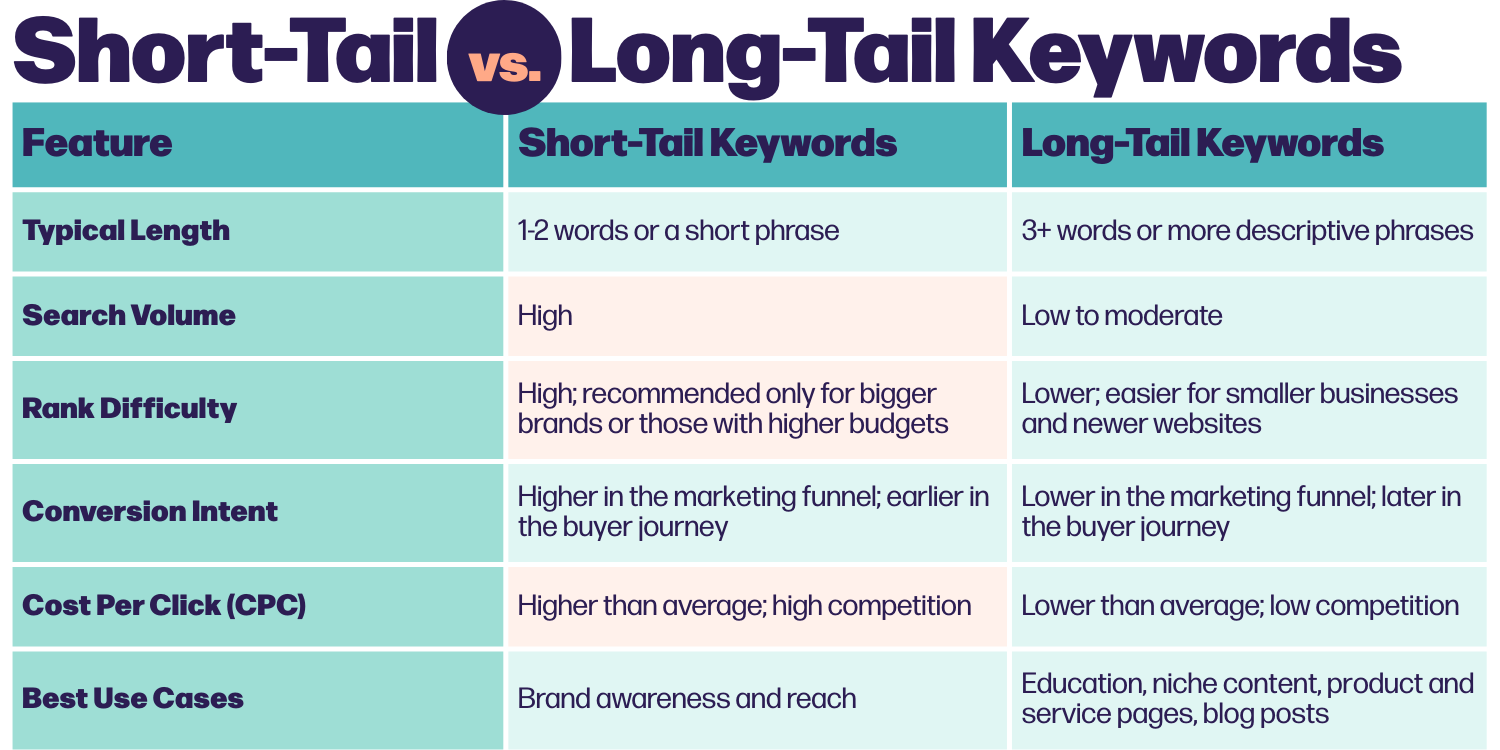
The flip side to that is that, because short-tail keywords are broad, ranking for them is rough. If you want to take the short-tail route, know that you’ll be playing in search waters dominated by high-authority sites with deep pockets. That means many growing or minority-owned businesses simply won’t be able to compete. Long-tail keywords give those brands a chance to speak more directly and meaningfully to a much smaller audience pool—probably farther down the funnel anyway.
Someone who searches “snacks” may simply be seeking a definition or getting ideas, while someone who searches “gluten-free snacks for the office” is more likely ready to buy.
Where does each keyword type fit in my marketing strategy?
Your keyword choices will depend on whether you’re targeting top of funnel or bottom of funnel.
Think of short-tail keywords as the “top of funnel.” They work when you’re trying to get noticed, build brand awareness or attract a general audience. If you sell tech tools, short-tail might catch people who are exploring general “business software.” If you’re in food and beverage, “healthy snacks” could pull in curious health-conscious browsers.
Long-tail keywords are often more “middle or bottom of funnel.” They catch people who already know what they want, and maybe even what budget or features they care about. For a kids’ toy brand, a long-tail keyword might be “safe educational toys for toddlers age 2-4.” For a law firm, maybe “small business contract lawyer near me.” By targeting users with long-tail keywords, you speak directly to intent.
The smartest strategy isn’t either/or—it’s both. Use short-tail where you need visibility and high-level messaging, and then use long-tail where you need specificity and action-oriented messaging, like on blog posts, FAQ pages or product listings.
How do I elevate my keyword strategy?
Short-tail keywords are like store signage next to the freeway, allowing you to share your presence broadly, though not always at the right time to the right people. Long-tail keywords are more like in-store shelf signage, reaching a much smaller number of people but reaching the right people.
If your brand is still growing, your budgets are tight and you need results that move the needle, lean into long-tail. That said, don’t ignore short-tail entirely. Use them as billboards to build visibility and top-of-funnel awareness. When you ensure your tailored long-tail content always supports your general short-tail keywords, you’ll answer actual questions, speak to real problems, and convert new customers.
You don’t need to develop your keyword strategy all on your own, though. Our search engine marketing experts would love to chat with you about your content needs and maybe even share tools to put you on the path to keyword-driven decision-making. Click the button below to talk to our “award-winning digital marketing agency in Los Angeles” today! (See what we did there?)
Cody H. Owens,
Content Director